
ENR Use License: Join the Movement
As Enhanced Natural Regeneration (ENR) gains momentum, we want to ensure that every organization—from small community groups to larger environmental entities—has the tools to implement this methodology with integrity. To support the widespread adoption of “wild” sapling transplanting and on-site nurseries, we are introducing a flexible Micro License. This system is designed to be accessible while maintaining the high standards of the ENR brand. By securing a license, you gain more than just a framework for reforestation; you gain a recognized seal of ecological authenticity for your project.
Transparent Scaling for Every Project
The licensing structure is built on the principle of accessibility, ensuring that cost is never a barrier to ecological repair. For small-scale restoration projects under 2 hectares, the ENR Use License a nominal fee of $10 applies. For mid-sized initiatives between 2 and 5 hectares, a fee of just $29 applies, while larger projects exceeding 5 hectares are covered for a mere $39. Licensed partners receive exclusive permission to feature the ENR logo on their marketing materials and social media channels. Furthermore, you will receive a “Verified ENR Partner” digital badge, signaling to your audience that your reforestation efforts follow a scientifically grounded, Indigenous-inspired methodology.
A Shared Commitment to the Boreal
By becoming a licensed partner, you help build a network of practitioners dedicated to resilient, site-specific forest recovery. This license isn’t just a fee; it’s a commitment to a methodology that respects local genetics and reduces industrial footprints. We invite you to display your “Verified ENR Partner” badge with pride, showing the world that your project is rooted in the proven principles of Enhanced Natural Regeneration. Together, we can restore the heart of the boreal.
Use License Methodology (Boreal Forest)
The following criteria are designed to ensure high survival rates for transplanted “wild” saplings while maintaining the integrity of the donor and recipient sites.
1. Species-Specific Site Matching
While species identification is the first step, matching the tree to its ideal soil and moisture regime is critical for long-term growth. Species identification is relatively basic and is best demonstrated with a knowledgeable crew member. Alternatively, online juvenile species identification is available.
| Species | Primary Habitat Target | Notes |
| Black Spruce | Low-lying, boggy, or peatland areas. | Highly tolerant of acidic, wet soils. |
| White Spruce | Well-drained upland soils; silty or loamy. | Avoid stagnant water; prefers nutrient-rich sites. |
| Balsam Fir | Well-drained upland soils; silty or loamy. | Avoid stagnant water; prefers nutrient-rich sites. |
| Jack Pine | Sandy, rocky, or nutrient-poor “dry” sites. | Excellent for rapid cover in well-drained burn sites. |
| Trembling Aspen | Firebreaks; upland sites with mineral soil. | Used for “greenstripping” due to lower flammability. |
2. Sapling Selection (The “Vigor” Rule)
Workers should only move saplings that have the best chance of surviving the “transplant shock.”
- Height Limit: Select saplings between 10 cm and 30 cm. Larger trees suffer more root loss during extraction.
- The 3-S Rule: Ensure the sapling is Straight, Single-leadered (no split tops), and Strong (no visible pests or fungal scarring). (Generally healthy looking)
3. Extraction and Handling
The methodology must emphasize protecting the root system, which is the “engine” of the tree.
- Root Ball Integrity: Extracting divots (majority of the roots encapsulated within a clump of soil) makes for a reliable method of transplanting, especially when making firebreaks where transit is short.
- Sufficient amount of root extraction. (about the same height as the the sapling)
- The “Goldilocks” Timing: Transplanting should occur during dormancy (early spring or in the fall).
- Root Exposure: Roots should never be exposed to direct air for prolonged periods. Sapling roots should be kept damp and cool during transit prior to transplantation.
4. Firebreak Geometry and Composition
The firebreak need not be a perfect straight line but must be functional.
- Fuel Discontinuity: Within the minimum 100-foot wide firebreak, all conifer saplings transplanted outside the intended firebreak area.
- Aspen Density: Target a minimum density of approximately 1 stem per 2 meters within the firebreak to create a continuous canopy of deciduous, moisture-retaining leaves.
5. Planting Technique and Spacing (Conifers)
Proper placement in the “disturbed area” prevents competition between saplings.
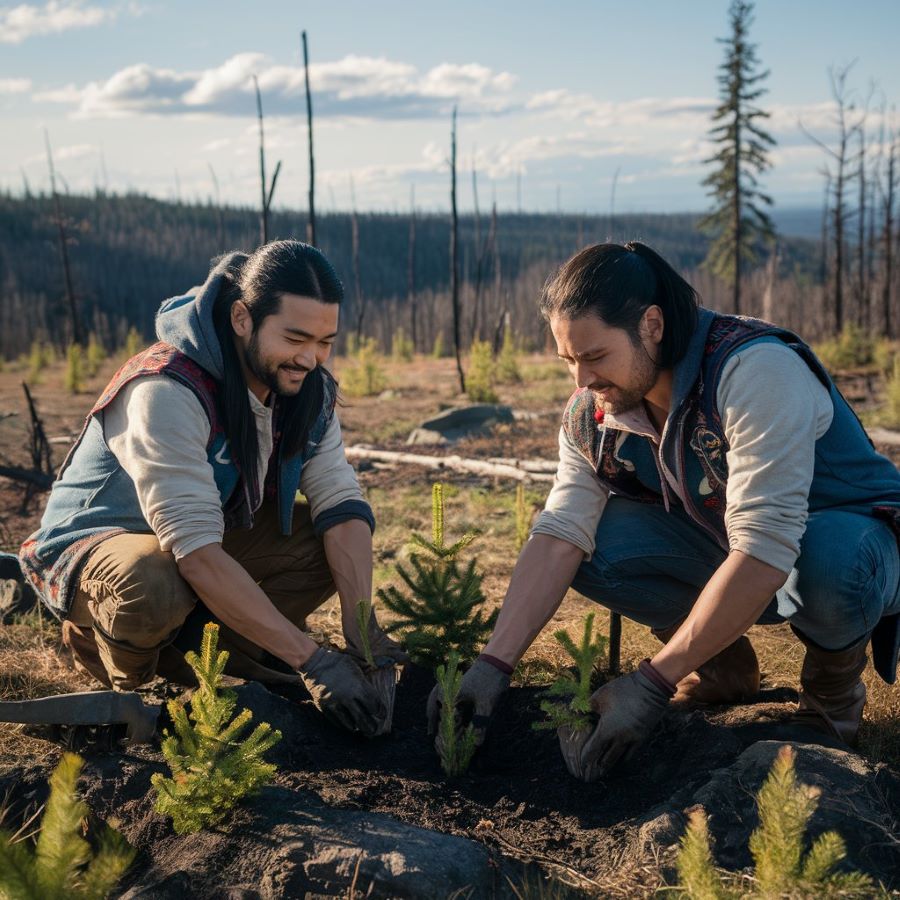
- Micro-site Selection: Planting into soil so as to set roots deeply or transplanting divits deep and level to the adjacent surface. (transplanting shallow, hooks the roots and can stunt growth)
- Once planted, the soil should be tamped down firmly to remove air pockets and give roots a good connection.
- Spacing: In logged-out or forest fired areas, maintain an approximate distance of 2 meters between transplants to ensure they don’t compete for the same root space as they mature.
Cost-Effective Implementation Tip
Firebreaks are an investment. ENR firebreaks are probably the most cost-effective way to make biological fire barriers. It is recommended to do a follow-up rudimentary transplanting repair on your firebreak the following year as emerging juvenile conifers can take hold. Protect your investment.